
Published September 25, 2025 at 12:00 a.m. CT by the Mississippi Artificial Intelligence Network.
STARKVILLE, Miss.—The Artificial Intelligence Legislative Task Force (AI Legislative Task Force) chaired by state Sen. Bart Williams of Starkville and state Rep. Jill Ford of Madison held its September meeting at Mississippi State on Sept. 25. There, members gained insight into how the university supports the state’s position as a national and global technology and innovation leader.
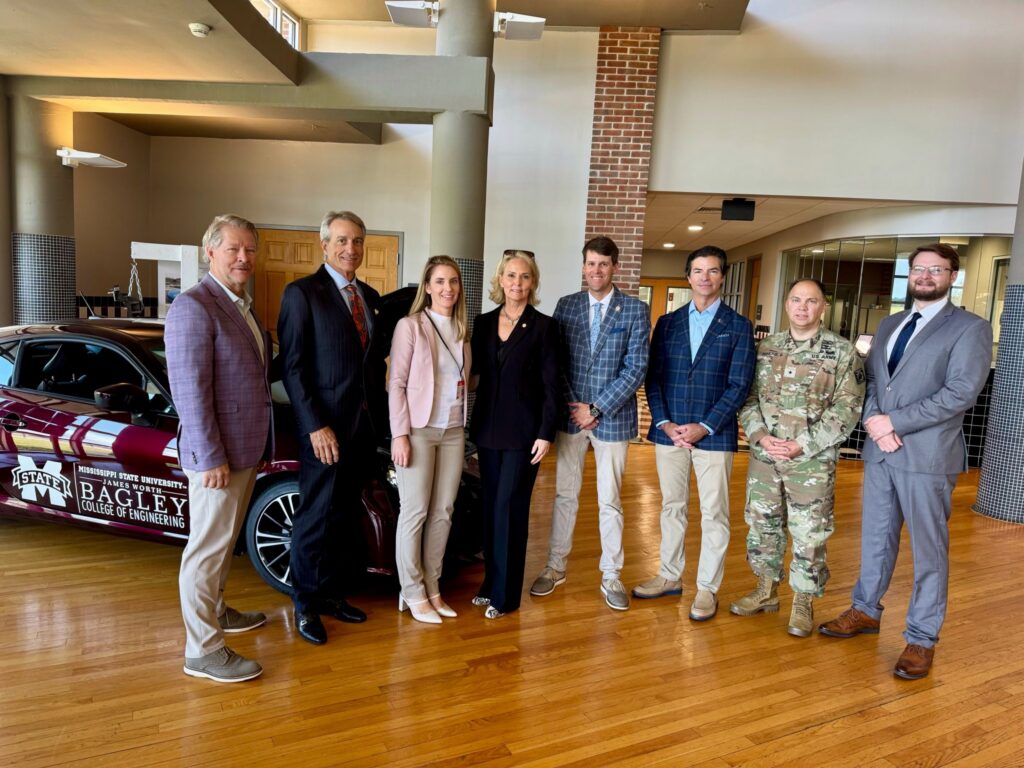
“We are a tech destination,” Williams emphasized. “We’re on the radar throughout the nation thanks to the leadership of many in this room, and we want to continue to do that.”
AI Legislative Task Force Hears From MSU Leaders
MSU Provost and Executive Vice President David Shaw said it is crucial to have engaging conversations about “a whole suite of emerging technologies.”
“We’re so proud that our state is taking a leadership role. We want to listen to you and be challenged by you, and we can work together to keep this state in the forefront—not just trying to figure out how to regulate AI but how to embrace it in a very holistic, but also responsible way,” Shaw said
Research Infrastructure at Mississippi State
MSU Vice President for Research and Economic Development Julie Jordan is an ex-officio member of the AI Legislative Task Force. She also helped lead tours of key university research centers.
Jordan said Mississippi now holds a coveted position. Leaders showed foresight by investing in infrastructure over the past decades. As a result, the state built supercomputing data centers and cutting-edge technology. This lets Mississippi move quickly in the age of AI.
“One limitation for AI development nationally and globally is the combination of power and space—but the state of Mississippi has invested in building that type of infrastructure right here at Mississippi State University, so we’re poised to move quickly on any needs the state has,” Jordan said.
“This is also why we must maintain our leading edge. It takes investment today to be ready for the opportunities that come tomorrow,” she added.
Touring MSU Research Centers
For example, CAVS Executive Director Clay Walden showcased his center’s work on off-road autonomous vehicles, among other research areas. CAVS is home to the university’s EcoCAR student team. Notably, that team has brought MSU three national championships in advanced automotive engineering.
“There is not an area at CAVS where machine learning and AI is not involved. It permeates everything we do,” Walden said.
Alex Thomasson also led a tour of one of the university’s newest research centers: the Agriculture Autonomy Institute. Similarly, this institute transforms decision-making in agriculture through data-driven insights.
Presentations on AI Progress
Presenters outlined the rapid pace of AI progress. Jonathan Barlow, associate director and assistant professor for MSU’s Data Science Program. He discussed how researchers develop and advance AI. He also explained how AI functions as it gains logic and reasoning. Computer Science and Engineering Department Head and Professor Andy Perkins described many employment opportunities for MSU graduates. He also touted MSU’s three designations as a Center of Academic Excellence for Cyber Operations, Cyber Research and Cyber Defense.
MSU researchers also are looking at issues that include ethics, privacy and policy related to AI application and development.
The AI Legislative Task Force and Statewide AI Work
Mississippi continues to invest in AI research, infrastructure, and policy. In addition, the Mississippi Artificial Intelligence Network (MAIN) supports statewide AI education, training, and workforce readiness. Together, these efforts help the state prepare for an AI-driven economy. To learn more, explore MAIN’s mission, partners, and AI courses.