
Established June 2025
AI Workforce Readiness Council
The AI Workforce Readiness Council helps align Mississippi’s AI talent pipeline across K-12, postsecondary education, workforce training, industry, and public-sector needs.
Statewide coordination
Shared
AI readiness
- Statewide
AI Priorities - Competency
Framework - Business and
Industry Alignment
Current Full Report
Mississippi Statewide AI Framework
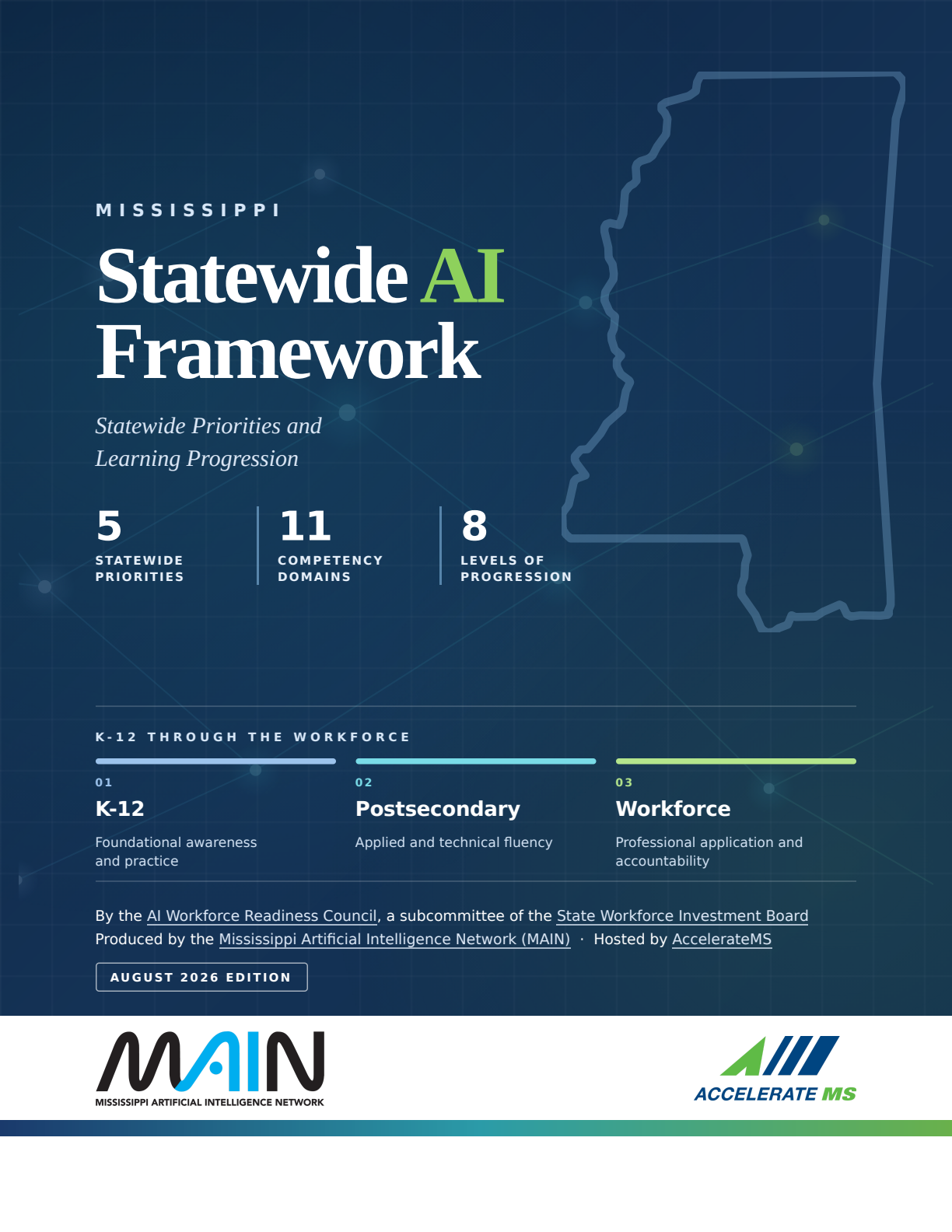
The Mississippi Statewide AI Framework is a voluntary competency framework prepared by the Mississippi Artificial Intelligence Network (MAIN) for the AI Workforce Readiness Council. It describes what a Mississippian should be able to do with artificial intelligence at eight points from elementary school through senior career leadership. It is a strategic point of alignment and a leadership-oriented guide for educators, postsecondary institutions, public agencies, and industry partners.
Full Framework Report
August 2026 Edition
The August 2026 Edition is the current full framework and supersedes the April 2026 Edition.
MAIN produces and maintains the framework for the AI Workforce Readiness Council. AccelerateMS, Mississippi’s Office of Workforce Development, hosts the published edition.
August 2026 edition
How the framework is organized
- Statewide priorities and definitions
- Mississippi legal and policy foundation
- AI Learning Progression
- Alignment and crosswalks
- Governance and use
Governance and review: The AI Workforce Readiness Council oversees the framework, with MAIN responsible for drafting and document maintenance. AccelerateMS hosts the published edition. The framework is reviewed on a fixed cycle each January, and each edition carries its publication date and a record of what changed.
The Mississippi Department of Education’s adopted computer science standards are separate instruments with their own authority; this framework does not replace them.
Definition
What is AI workforce readiness?
AI workforce readiness is the capacity of a state’s workers, employers, and education systems to use artificial intelligence effectively and responsibly on the job. It covers practical AI skills, alignment between training programs and employer needs, and the guidance workers need to adopt AI tools with confidence. Mississippi’s AI Workforce Readiness Council coordinates this work statewide, connecting education, industry, and government so training reflects what employers actually need.
Current Edition
What changed in the August 2026 edition
The August edition retains the statewide priorities, eleven competency domains, and learning progression introduced in April 2026. It adds a Mississippi legal and policy foundation covering enacted laws, adopted computer science standards, governing bodies and their current positions, and the federal policy environment. Factual and policy claims link to primary sources, with two legal references using public repositories where official free text is unavailable.
The revised Progression Mapping describes observable capabilities that apply across technologies. Postsecondary and workforce levels serve as entry points for learners with different backgrounds; they do not require completion of a single sequence after high school.
Four crosswalks connect the domains to state, federal, and international reference instruments. New governance and measurement sections establish a January review cycle and draw on indicators the state already collects.
Expanded domains address differences between machine and human learning, intellectual property and training data, environmental and energy impacts, policy and regulatory literacy, and security risks involving agentic systems and synthetic media.
Council Resources
Shared priorities and a common AI learning path
The Council connects statewide AI priorities with a learning progression framework so institutions, employers, and public partners can use a common language for AI readiness. These resource pages introduce the priorities and learning progression. The current full report is linked above.
Council Foundation
Mississippi’s Statewide AI Priorities
The priorities define Mississippi’s shared direction for AI literacy, responsible use, data privacy and security, workforce readiness, statewide alignment, and measurable outcomes.
Learning Progression
Mississippi AI Learning Progression Framework
This resource presents the framework’s AI Learning Progression across eight points from elementary school through senior career leadership. It gives partners a shared AI readiness language. Use is voluntary, and institutions retain responsibility for curriculum.
State Policy Context
Artificial Intelligence Regulation Task Force
The AIR Task Force is separate from the Workforce Readiness Council. It was created by Senate Bill 2426 to study AI applications, risks, and policy recommendations for Mississippi.
Origin and Purpose
Why the Council exists
On June 12, 2025, Governor Tate Reeves announced the Mississippi AI Talent Accelerator Program, a $9.1 million initiative to expand AI, machine learning, and technical capacity across Mississippi’s institutions of higher learning.
Established through MAI-TAP
The Council is an advisory coordination body operating as a subcommittee of the State Workforce Investment Board. AccelerateMS hosts the framework’s published edition.
Shared direction
The Council develops shared language, priorities, and expectations across education and workforce. It has no authority to set standards, prescribe curriculum, or create policy.
Cross-sector representation
The Council is chaired by Dr. Kollin Napier, MAIN’s Chief Artificial Intelligence Officer. It brings together education, workforce, government, research, and industry partners so no single perspective drives the work alone.
How the Council Works
Three working teams, one coordinated effort
The AI Workforce Readiness Council organizes its work through three focused teams. Together, they connect statewide direction, learning expectations, and employer demand.
Statewide AI Priorities
This team identifies Mississippi’s highest-priority AI focus areas and helps orient education, workforce, and policy conversations toward shared goals.
Competency Framework
This team supports the shared learning progression that describes observable AI capability from elementary school through postsecondary and workforce entry points.
Business and Industry Alignment
This team connects AI education to real workforce demand across healthcare, manufacturing, agriculture, technology, public service, and other sectors.
MAI-TAP Investment
Born from a statewide AI talent investment
MAI-TAP awarded $9.1 million in grants to eight institutions of higher learning. The program is a partnership between AccelerateMS, the Mississippi Development Authority, and Amazon Web Services.
Mississippi State University
$2.2M
Jackson State University
$1.3M
University of Southern Mississippi
$1.24M
Alcorn State University
$1.15M
Tougaloo College
$1.08M
Millsaps College
$1.0M
Mississippi College
$723K
Belhaven University
$390K
Additional institutions contribute through existing funding and collaborative efforts, including Copiah-Lincoln Community College, Mississippi Gulf Coast Community College, Hinds Community College, and the University of Mississippi.
Council Membership
Council participating organizations and institutions
The Council brings together organizations and institutions from Mississippi’s education, workforce, industry, and public-sector landscape. Listing indicates participation in the Council, not institutional review or endorsement of this framework.
- AccelerateMS
- Amazon Web Services
- C Spire
- NVIDIA
- Oxford-Lafayette Economic Development Foundation
- Mississippi Department of Information Technology Services
- Alcorn State University
- Mississippi Department of Education
- Belhaven University
- Mississippi Institutions of Higher Learning
- Copiah-Lincoln Community College
- Mississippi Community College Board
- Hinds Community College
- Mississippi Gulf Coast Community College
- Jackson State University
- Millsaps College
- Mississippi State University
- Center for Cyber Education
- University of Mississippi
- Pearl Public School District
- Mississippi College
- Tougaloo College
- University of Mississippi Medical Center
- University of Southern Mississippi
Council Scope
What the Council does and does not do
The Council is a coordination body. It clarifies statewide AI readiness work without replacing local program design, institutional authority, or formal policy processes.
What the Council does
- Coordinates a shared competency framework and learning progression across K-12, postsecondary education, and workforce.
- Identifies Mississippi’s strategic AI priorities across education and industry.
- Aligns AI education with employer needs and sector-specific workforce demand.
- Makes handoff expectations visible at key transition points in a learner’s journey.
- Reviews and updates its work as AI evolves.
What the Council does not do
- It does not set state standards, required assessments, or proficiency cut scores.
- It does not prescribe courses, curriculum, lesson plans, tools, platforms, or vendors.
- It does not establish policy, endorsements, compliance requirements, or accountability structures.
- It does not replace detailed program design at individual institutions.
- It does not create legislation, requirements, or mandates of any kind.