
Published August 4, 2026 at 7:00 p.m. CT by the Mississippi Artificial Intelligence Network.
Update · October 9, 2026: Micro-credentials may take the form of MAIN certificates of completion or provider certificates delivered through Coursera. Awards and eligible K–12 CEUs vary by course. See the current course catalog for award issuers and completion requirements.
BILOXI, Miss. — Many HR teams hear that they are behind on AI in HR. However, their own industry research points somewhere else. That was the starting point for a Tuesday afternoon session by Dr. Kollin Napier, Chief Artificial Intelligence Officer of the Mississippi Artificial Intelligence Network (MAIN), at the Mississippi SHRM 2026 Conference at the Beau Rivage in Biloxi.
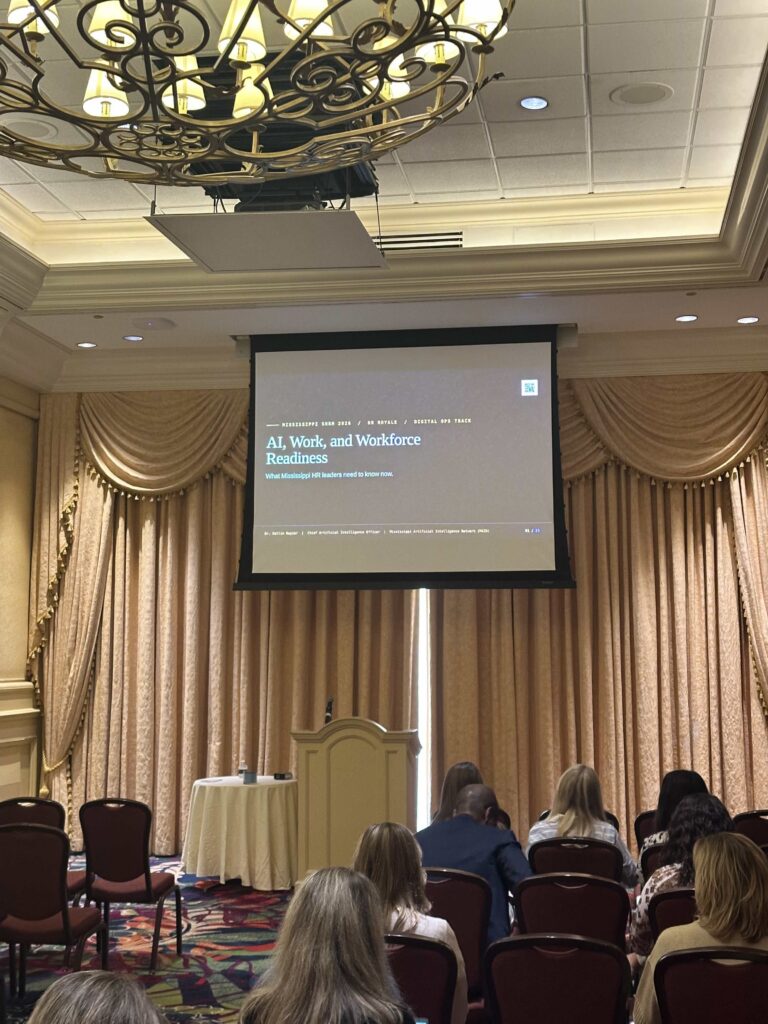
The session was titled “AI, Work, and Workforce Readiness: What Mississippi HR leaders need to know now.” It covered adoption patterns across HR functions, the review burden that follows productivity gains, and HR’s role when a tool affects an employment decision. In addition, Napier asked attendees to take three steps within 90 days.
What Mississippi SHRM attendees heard about AI in HR
SHRM’s State of AI in HR 2026 report found that 54 percent of organizations have not adopted any form of AI in HR and have no plans to do so this year. The report draws on 1,908 HR professionals. Recruiting is the most common use case. Even so, just 27 percent of organizations report using AI there.
Napier’s argument was not that adoption is low. Instead, he said the more common exposure sits somewhere else. AI arrived inside software that organizations had already bought for other reasons. As a result, it often entered the workplace without a deliberate decision.
“Stop asking whether your organization uses AI. Ask what tasks people already use it for, and whose account they are on,” Napier said.
That distinction matters for HR. For example, a vendor update can add drafting, summarizing, or scoring features to a system the team already uses daily. Because no one signed a new contract, the change can pass without review.
Who hears about an AI rollout, and who gets evaluated by one
Napier also cited SHRM’s Navigating AI in the Workplace: 2026 report, a survey of 5,875 U.S. workers. Among directors and above, 74 percent said leaders told them about a possible AI rollout before adoption. Managers reported 55 percent. However, only 33 percent of individual contributors recalled any advance notice.
Those same individual contributors are often the people a tool screens, scores, or schedules. Therefore the gap is more than a communication problem. It also shapes trust, day-to-day use, and the quality of feedback leaders get after launch.
HR absorbs the consequences but is often left out of AI strategy
The SHRM HR report also found that 52 percent of organizations do not involve HR directly, or in a cross-functional way, in overall AI strategy. In other words, the function that handles hiring records, accommodation requests, discipline, and employee questions is frequently absent when the choice gets made.
Napier framed this as a practical risk rather than a turf issue. When a tool shapes who advances in a hiring process, HR owns the file and the explanation. So HR needs to see the tool before employees do, not after.
Three steps Mississippi SHRM attendees can take in 90 days
Napier asked HR leaders to commit to three actions. None of them requires new budget. All of them require a decision.
- Inventory the AI already inside the systems you own. Review your HRIS, applicant tracking system, payroll platform, and collaboration suite for AI features that are already turned on.
- Give employees one approved tool, with training that repeats. A single sanctioned option cuts down on personal accounts. Also, one session is not training.
- Keep records of AI-assisted employment decisions. Note where a tool contributed to screening, ranking, scheduling, or review, and note who checked the output.
Employers that want a starting document can use MAIN’s no-cost AI policy and guidance template along with MAIN’s AI playbooks for Mississippi workplaces.
MAIN training covers AI in HR and every other occupation
Napier closed on MAIN’s role. Through MAIN, Mississippi educators, public sector employees, and workers in any occupation can take AI training at no cost. Sessions are hands on keyboard rather than lecture only. Eligible courses offer micro-credentials in the form of MAIN certificates of completion or provider certificates delivered through Coursera. Qualifying courses also offer K–12 CEUs through MGCCC, subject to course requirements.
For HR teams, that matters in two ways. First, HR staff can build working knowledge of AI in HR before they weigh a vendor claim. Second, HR can point employees toward practical training instead of relying on a policy alone.
Key takeaways from the Mississippi SHRM session
- Formal adoption remains limited. SHRM reports that 54 percent of organizations have no AI in HR and no plans to add it this year.
- Unmanaged exposure is the more common condition, because AI features arrive inside software organizations already own.
- Awareness tracks with seniority. While 74 percent of directors and above hear about a rollout in advance, only 33 percent of individual contributors do.
- HR is frequently excluded from strategy. In 52 percent of organizations, HR is not involved directly or cross-functionally.
- Three actions fit inside 90 days: inventory existing tools, approve one tool with repeat training, and document AI-assisted employment decisions.
After Mississippi SHRM: learn more and take the next step
Mississippi HR leaders who want a practical starting point can browse MAIN’s no-cost online AI training. Courses are open to learners across occupations, sectors, and experience levels.
Employers can also review MAIN’s resources for business and industry. Alternatively, they can contact MAIN about training for a team or a department.
Frequently asked questions
What was Dr. Napier’s Mississippi SHRM 2026 session about?
The session, “AI, Work, and Workforce Readiness,” covered AI adoption across HR functions, HR’s role when a tool affects an employment decision, and three steps HR teams can take within 90 days.
How many organizations have no AI in HR?
SHRM’s State of AI in HR 2026 report found that 54 percent of organizations have not adopted any form of AI in HR and have no plans to do so this year.
Why should HR be part of AI strategy?
HR handles the records, questions, and decisions a tool touches. SHRM found that 52 percent of organizations do not involve HR directly or cross-functionally in overall AI strategy, so the function that absorbs the consequences is often absent when the choice gets made.
What can an HR team do about AI in the next 90 days?
Inventory the AI already running inside systems the organization owns, approve one tool for employees and train on it repeatedly, and keep records of AI-assisted employment decisions.
Does MAIN charge for AI training?
No. MAIN offers free AI training to Mississippi educators, public sector employees, and workers in any occupation. Micro-credentials vary by course; qualifying courses offer K–12 CEUs through MGCCC for eligible educators.
Sources: SHRM, The State of AI in HR 2026 (1,908 HR professionals, fielded December 2025); SHRM, Navigating AI in the Workplace: 2026 (5,875 U.S. workers, fielded March–April 2026); and the Mississippi SHRM 2026 Conference program, held August 3–5, 2026 at the Beau Rivage in Biloxi.