
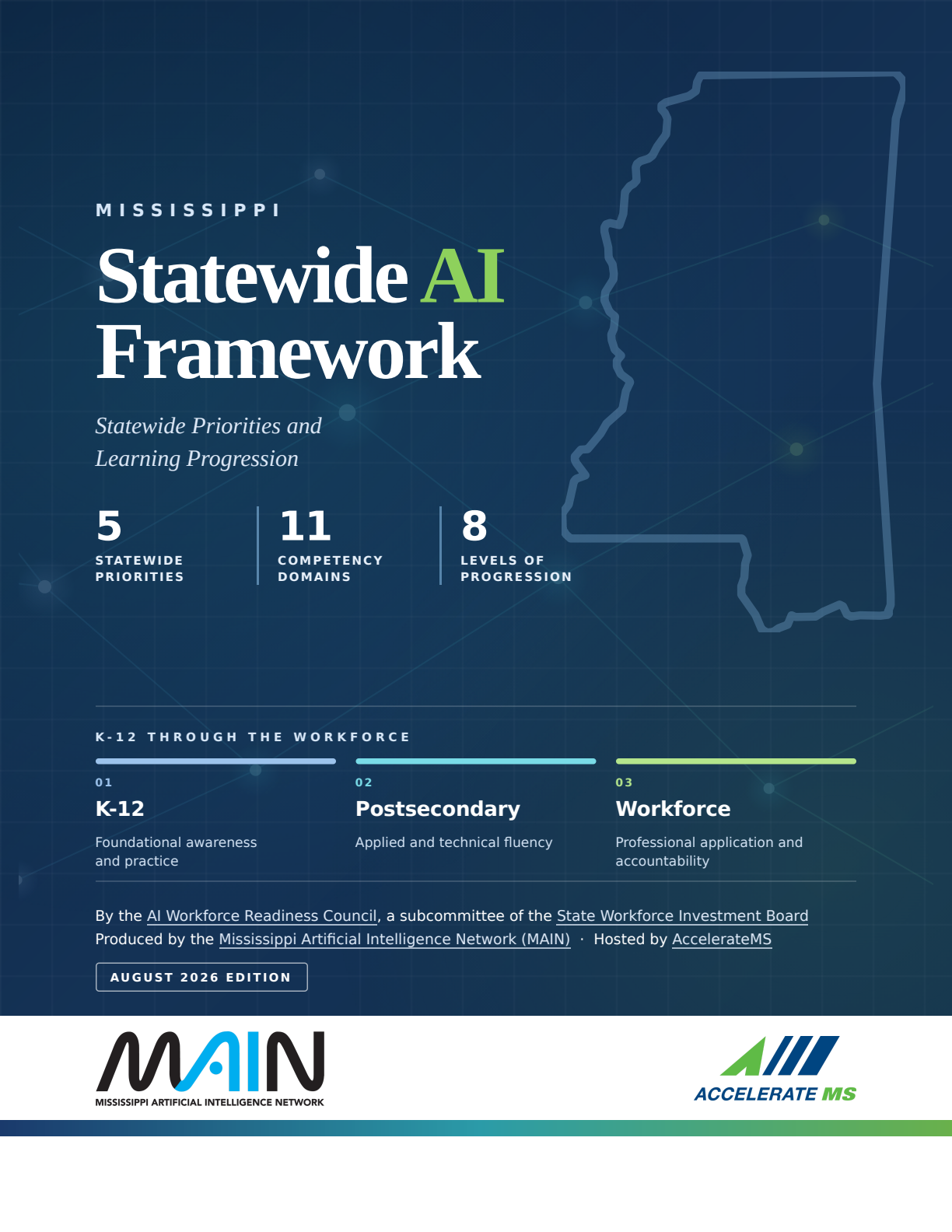
The August 2026 edition of the Mississippi Statewide AI Framework (PDF) is available through AccelerateMS. The update adds a Mississippi legal and policy foundation, revises the AI Learning Progression, and introduces crosswalks and a review process for educators, workforce partners, public agencies, and employers.
The Mississippi Artificial Intelligence Network (MAIN) produces and maintains the document for the AI Workforce Readiness Council, a subcommittee of the State Workforce Investment Board. AccelerateMS, Mississippi’s Office of Workforce Development, hosts the published edition on its State Workforce Investment Board page.
What changed since April
The April 2026 edition established the statewide priorities, eleven competency domains, and an initial learning progression. The August edition retains that structure and expands the guidance for using it.
A new Part Two sets out the Mississippi legal and policy foundation. It covers enacted laws, the state’s adopted computer science standards, governing bodies and their current positions, and the federal policy environment. Factual and policy claims are supported by primary sources, with links to the issuing bodies’ published records. The reference list identifies two legal citations that use public repositories because official free text is unavailable.
The competency domains now give more attention to differences between machine and human learning, intellectual property and training data, environmental and energy impacts, and policy and regulatory literacy. They also address emerging security risks involving agentic systems and synthetic media.
Capabilities and flexible entry points
The rewritten Progression Mapping describes capabilities that learners can demonstrate across technologies. Postsecondary and workforce levels function as entry points for people with different educational and professional backgrounds. A worker or career changer can enter at an appropriate level without completing every earlier stage.
In the revised Data Literacy and Data Stewardship entry, learners at the Early Career level redact and classify workplace data before it enters an external system, follow sector protocols, and record their decisions. A workforce trainer could review that work and its decision log to see how a participant applied those protocols.
Part Four adds four crosswalks. They connect the framework to the U.S. Department of Labor’s AI literacy framework, the OECD and European Commission’s AI literacy framework, Mississippi policy instruments, and the state’s 2026 College- and Career-Readiness Standards for Computer Science. Readers can use these comparisons to see where the framework relates to existing guidance and requirements.
Governance, measurement, and review
Part Five adds guidance on governance and use, including high-stakes decisions that require human review. Its measurement approach draws on indicators the state already collects, such as credential attainment, wage and employment outcomes, and course completions. Those indicators describe system activity and labor market conditions; they do not establish an individual learner’s AI proficiency.
The Council oversees the framework, with MAIN responsible for drafting and document maintenance. A scheduled review each January and defined triggers for updates between reviews help keep the document aligned with changes in law, standards, and guidance.
The framework remains voluntary. It creates no new state standards, required assessments, curriculum requirements, or obligations for institutions and employers. Existing laws and adopted standards retain their own authority.
Read the August 2026 framework on AccelerateMS (PDF), or visit MAIN’s AI Workforce Readiness Council page for the Council’s role, participating organizations, and related resources.