
News · Published · By Mississippi Artificial Intelligence Network (MAIN)
The September 15 AI for All workshop at Mississippi State University centered on the computing, training and support researchers need to move AI work from an idea into a repeatable workflow. Its program connected Mississippi’s university research-computing landscape with national resources available through ACCESS and the National Artificial Intelligence Research Resource.
Purdue University hosted the workshop in partnership with Arizona State University and Mississippi State. The event at The Mill in Starkville was part of a National Science Foundation and NAIRR Pilot initiative for researchers, faculty, graduate students and high-performance computing professionals.
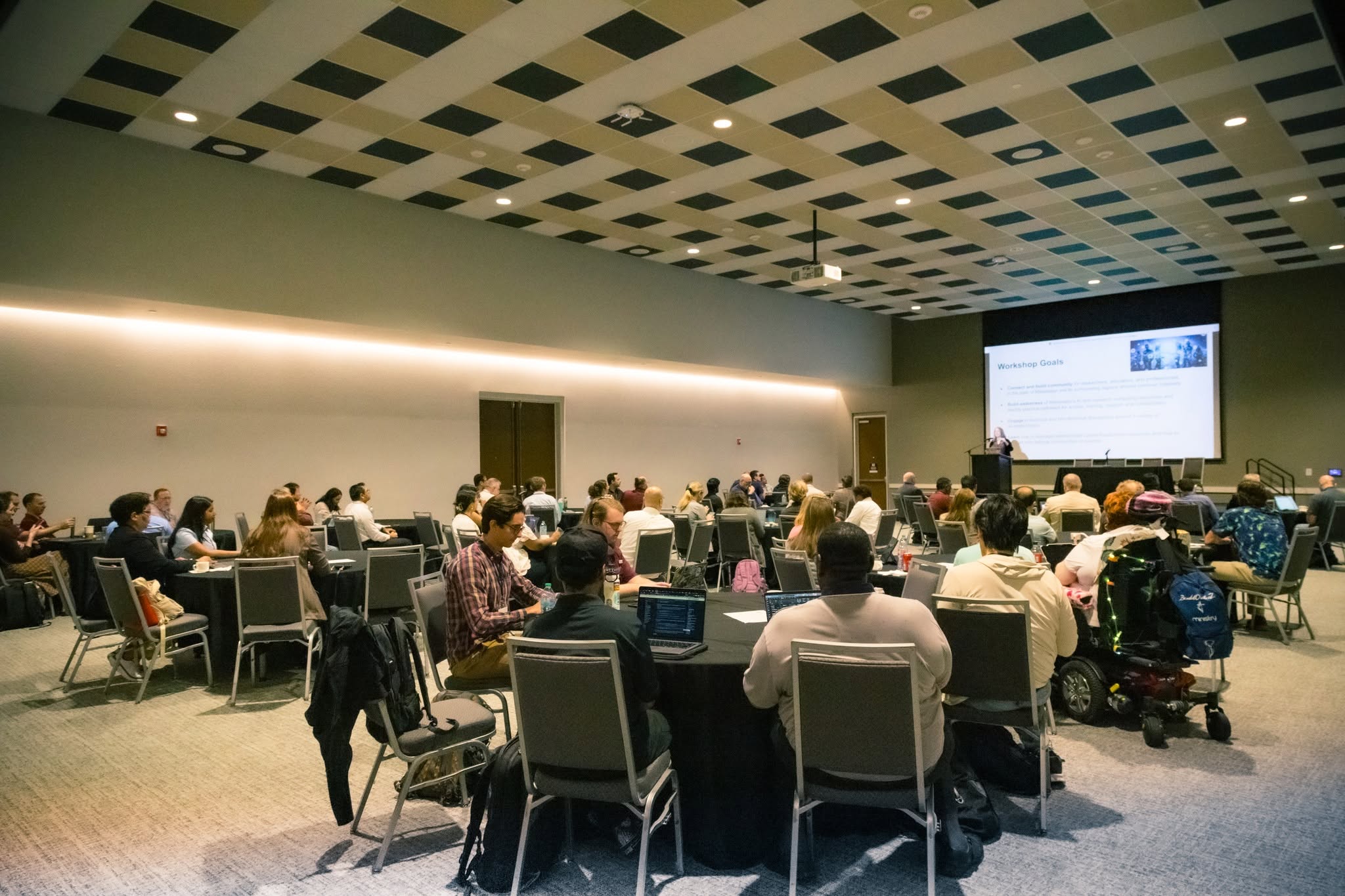
Access takes more than hardware
A panel on Mississippi’s research-computing infrastructure brought together representatives from Mississippi State, the University of Southern Mississippi, the University of Mississippi and Jackson State University. The published program focused on a practical challenge: advanced computing cannot support statewide research if people at smaller colleges, regional campuses and other institutions lack clear ways to access and use it.
The panel was designed to cover institutional capabilities alongside training, technical support and collaboration. That combination matters for faculty members and students who have a research question but may not have local access to specialized hardware or staff with high-performance computing experience.
From APIs to supercomputing
The program moved from resource navigation into hands-on technical work. Participants could learn how to request allocations through ACCESS and NAIRR, call an OpenAI-compatible language-model API from Python, build a basic AI agent and submit jobs to Purdue’s Anvil supercomputer. Advanced sessions addressed large-scale workloads, monitoring, checkpointing and reproducible deployment.
Those topics connect introductory AI development with the infrastructure required for more demanding research. They also make the pathway visible: start with a defined research task, learn the workflow, use shared resources and scale when the work requires it.
The National Science Foundation describes NAIRR as national infrastructure for access to computing, software, data, models, educational resources and expertise. On September 1, NSF announced an operations center intended to help move NAIRR from its pilot phase toward a sustained national capability.
A useful model for Mississippi
For Mississippi, the workshop addressed a basic question for AI research: who can access the infrastructure, and who gets enough support to use it well? Shared systems broaden participation only when institutions pair them with training, allocation guidance and people who can help researchers get started.
Researchers and educators at institutions without large local computing systems still need a practical route into advanced resources. The program linked that route to three things Mississippi can build on: shared infrastructure, clear allocation pathways and human support.