
Students at Mississippi Gulf Coast Community College’s Harrison County Campus are learning how to turn a business problem into an AI project. Their work is the subject of an October 20 WLOX report that puts a Mississippi community college classroom at the center of the conversation about AI and employment.
Wayne Francis, AI Strategist for the Mississippi Artificial Intelligence Network (MAIN), and Dr. Kollin Napier, MAIN’s Chief Artificial Intelligence Officer, participated in the coverage. The report connects classroom implementation with Napier’s discussion of how AI changes job tasks.
Learning to work through a business problem
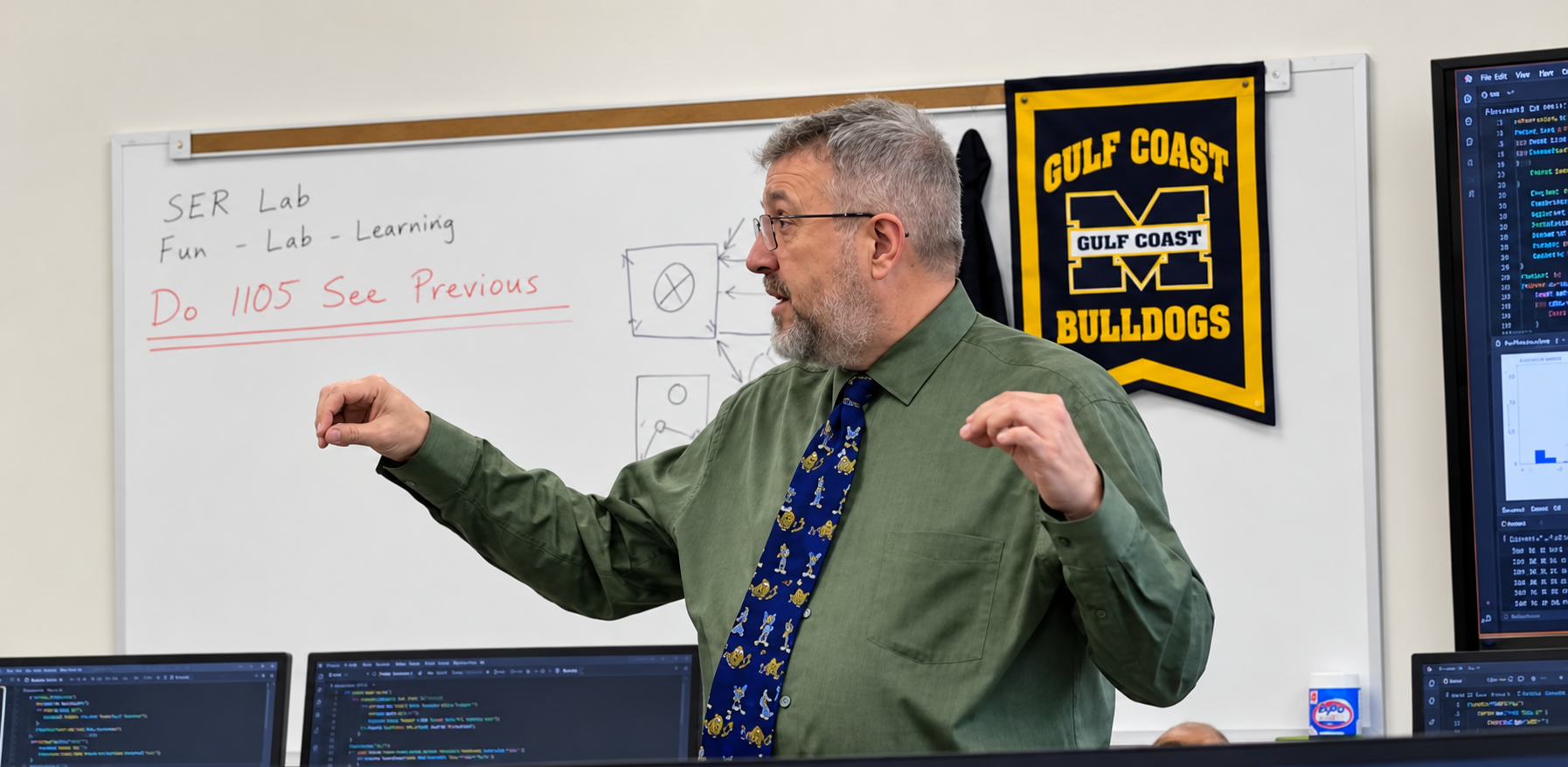
The course, IST 2911, Supervised Work Experience in Information Systems Technology, began in spring 2026 under Francis’s leadership, with instructional support from MGCCC Information Technology instructor Vic Gauthreaux. WLOX reported that enrollment grew from seven students in the spring to 11 in the fall.
Gauthreaux described businesses bringing problems for students to address with AI. Students must understand an organization’s needs before deciding how a tool could help.
MGCCC’s September account of the course describes practice with data preparation, model selection, document processing, semantic search and connected AI workflows. Students also evaluate generated results and document their technical choices. Their professional portfolios explain a project’s purpose, methods, limitations and resource needs.
For a prospective employer, that documentation offers something useful to examine alongside a demonstration: how a student understood the problem and reached a decision. The course gives students practice explaining the work behind an AI-supported result.
Preparing for changing job tasks
In the WLOX interview, Napier discussed AI’s effect on work by comparing it with earlier changes in spreadsheets and radiology technology. He described a shift toward “more oversight and judgement” as AI takes on some routine tasks. His comments frame AI education around the responsibilities people will carry as their work changes.
That perspective connects with the course’s emphasis on evaluating results. A student who can select a model also needs to explain its limitations and assess whether its output serves the organization’s purpose. MGCCC describes those decisions, along with responsible information handling, as part of the learning.
A community college example within Mississippi’s AI work
The classroom work shows how AI implementation can become part of higher education’s connection with local employers. Students encounter organizational needs while they are still learning, and the projects give them a setting in which to practice technical decisions and communicate their reasoning.
Francis’s teaching also connects with his broader implementation responsibilities at MAIN, which include project-based learning and solution architecture for agency and industry partners. MAIN, Mississippi’s statewide AI initiative, connects education with workforce preparation and practical adoption. MGCCC provides its operational and fiscal anchor.
Read MAIN’s earlier coverage of Francis and the project course for more background. Colleges and employers interested in discussing applied AI work can contact MAIN.
This article draws on WLOX’s October 20 reporting and MGCCC’s September 14 course account, with additional context from MAIN’s staff and institutional information. The embedded report is WLOX’s work.