
GULFPORT, Miss. — Seven Mississippi Gulf Coast Community College students began turning artificial intelligence concepts into practical project work during the first offering of IST 2911, Supervised Work Experience in Information Systems Technology, at MGCCC’s Harrison County Campus.
The course launched in spring 2026 under the leadership of Wayne Francis, AI Strategist for the Mississippi Artificial Intelligence Network (MAIN), with instructional support from MGCCC Information Technology instructor Vic Gauthreaux. A new fall cohort is continuing the work, according to a September 14 news release from Mississippi Gulf Coast Community College.
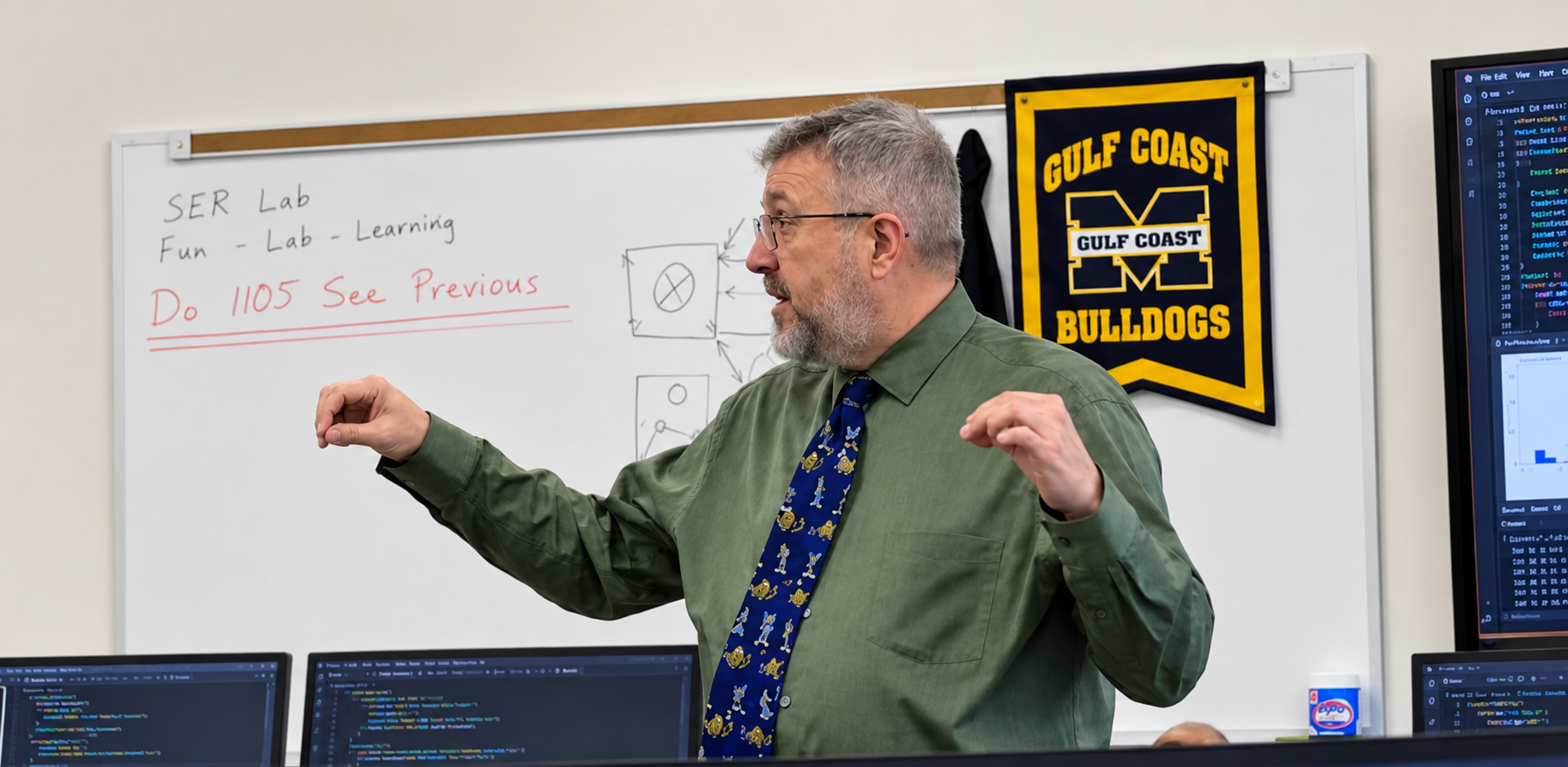
From AI prompts to working systems
IST 2911 asks students to do more than produce an answer with an AI tool. They learn to define the problem first, identify the people the work is intended to serve and determine what information, safeguards and resources a useful solution would require.
The spring cohort worked with data preparation, AI model selection, smart document processing, semantic search, conversational interfaces and connected AI workflows. Students also practiced protecting sensitive information, evaluating AI-generated results and documenting the technical choices behind a project.
“Students need more than an understanding of how to use an AI tool,” Gauthreaux said in the MGCCC release.
Gauthreaux emphasized that learners must be able to judge where AI can provide value and build solutions that are secure, responsible and practical.
The inaugural cohort included Elizabeth Hachiya, Reece Blackburn, Robert Furuglyas, Anis Halai, Allen Pulliam, Christina Schmidt and Tommie Walker.
Making technical decisions visible
Students are developing professional portfolios that explain the purpose and method of each project, not just its final output. The portfolios also identify limitations and resource needs, giving students practice communicating why they selected a particular approach or technology.
That documentation is an important part of applied AI work. A prototype may appear convincing while still relying on incomplete information, exposing sensitive data or producing results that have not been checked. Recording the sources, constraints, evaluation process and human responsibilities makes a project easier for others to assess and improve.
Preparing for work with community partners
MGCCC reported that relationships with local and state agencies are creating opportunities for students to apply their skills to organizational and community needs. The projects are intended to fit established workplace processes, giving students experience with the practical conditions that surround implementation.
The fall 2026 cohort is building on the spring group’s foundation by developing early concepts and prototypes further. Students are also examining what it would take for an AI-supported workflow to operate responsibly over time in a government agency, local business or other organization.
For Francis, the course connects directly with his work through MAIN. He supervises project-based learning initiatives, develops solution architectures for Mississippi agency and industry partners, and helps teams prepare for practical AI workflow implementation. In IST 2911, students encounter that same progression: begin with a defined need, choose technology deliberately, protect the information involved and keep people responsible for evaluating the result.
Building Mississippi’s applied AI workforce
The course reflects a growing workforce need for professionals who understand both AI tools and the environments in which those tools operate. That includes the people affected by a system, the data it uses, the security boundaries around it and the resources required to maintain it.
By practicing those decisions in project-based coursework, MGCCC students can enter the workforce with evidence of how they approached a problem—not only a demonstration of what an AI system produced.
Learn more about Wayne Francis and MAIN’s project-based implementation work or explore MAIN’s no-cost AI learning opportunities.
Source note: Course details, participant names and the Vic Gauthreaux quotation are attributed to a September 14, 2026 news release from Mississippi Gulf Coast Community College supplied to MAIN for this article.