
Published July 29, 2026 at 7:00 p.m. CT by the Mississippi Artificial Intelligence Network.
JACKSON, Miss. — July 29, 2026 — America must lead in artificial intelligence, but the national debate over how to balance open access, innovation and safety is far from settled. Dr. Kollin Napier, Chief Artificial Intelligence Officer of the Mississippi Artificial Intelligence Network (MAIN), joined Gerard Gibert on SuperTalk Mississippi’s MidDays on Wednesday to explain why federal policy and state-level implementation are both essential to U.S. AI leadership.
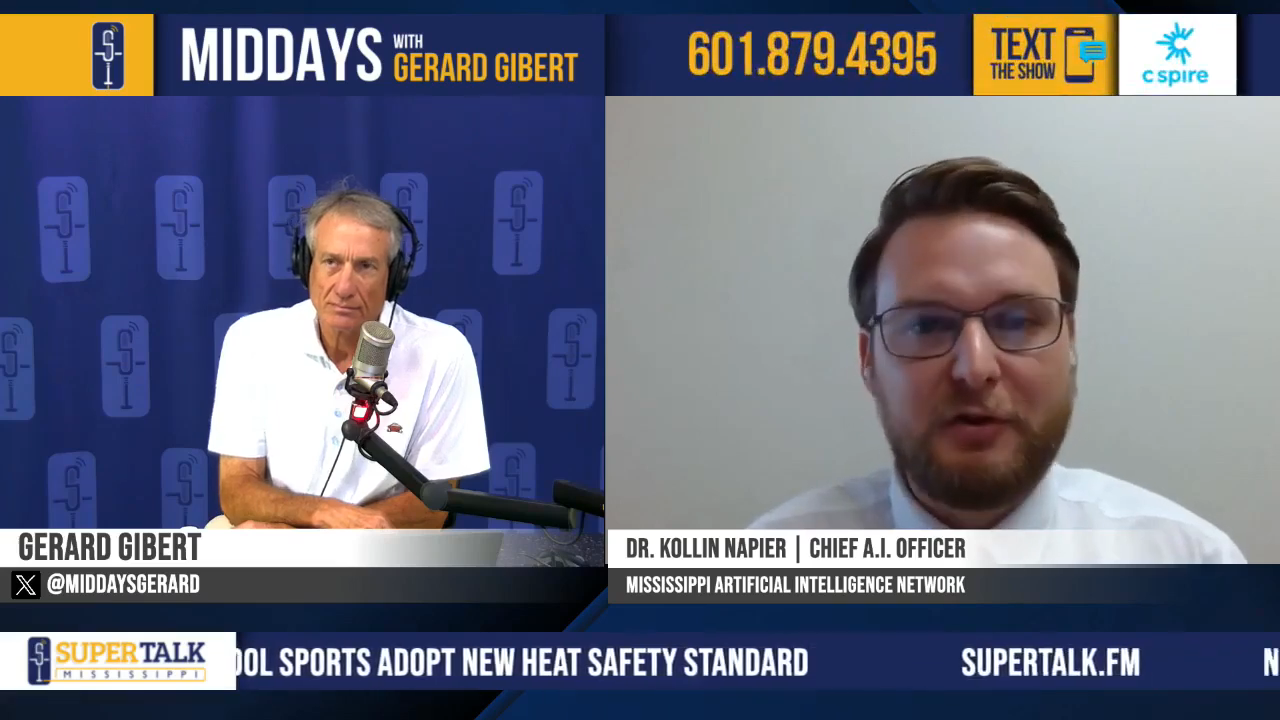
Watch the full SuperTalk Mississippi interview
Watch Gerard Gibert’s full MidDays conversation with Dr. Kollin Napier on American AI leadership, open-weight models, AI safety and Mississippi’s hands-on workforce strategy.
Watch “The Future of A.I. in the Magnolia State” on YouTube.
The conversation covered the national debate over open-weight AI models, Mississippi’s statewide approach to AI workforce readiness, hands-on training for educators and public employees, the role of human judgment and the purpose of controlled AI safety evaluations.
What Dr. Napier said about American AI leadership
Napier said the United States should continue building and deploying world-class AI while addressing genuine risks through targeted policy, testing and enforcement. The discussion followed a July 24 industry letter backed by NVIDIA, Microsoft, Meta, IBM and other technology organizations. The letter urged federal policymakers to avoid broad, premature restrictions on open-weight models that could weaken competition or push innovation overseas. Additional companies joined the coalition after the letter’s initial release, underscoring how quickly the policy debate is evolving.
Open-weight models make a model’s trained parameters available for download and use. That can allow businesses, universities, public institutions and developers to run or adapt AI on their own infrastructure. Napier emphasized that access can expand innovation, but responsible adoption still requires cybersecurity, governance, testing and human oversight.
“Federal policy sets the ceiling. States decide what actually gets used, and that is the half Mississippi is working.”
That distinction is central to MAIN’s work. National rules shape the boundaries for AI development, but state institutions, educators, employers and public agencies determine whether people can use the technology safely and productively in their daily work.
Mississippi’s hands-on model for AI adoption
Through MAIN, Mississippians can access no-cost AI courses and certification opportunities designed for any occupation or sector. MAIN also works with education, government and industry to make AI practical through workshops, demonstrations and implementation support.
Napier described “hands on keyboard” experience as the point where abstract concerns become practical questions. When participants build something themselves, the conversation changes from what AI might do someday to what it can do in their job on Monday.
He pointed to a recent hands-on session in which Anthropic, the company behind Claude, worked with Mississippi public-sector employees to build AI applications in a controlled learning environment. Participants left with direct experience and a clearer understanding of the steps their agencies would need to consider before implementation.
Napier also recently led a two-day workshop in Atlanta for representatives of more than 300 higher education institutions. The focus was moving beyond general awareness of chatbots toward vision, strategy, governance and responsible adoption.
AI should support human judgment, not replace it
During the interview, Napier stressed that AI should enable people to move from repetitive task execution toward judgment and oversight. People remain responsible for objectives, context, verification and final decisions.
That principle applies across education, state government, healthcare, manufacturing and other sectors. AI can rapidly process information and identify patterns, but organizations still need clear policies, trained employees and accountable decision-makers. Mississippi’s approach connects workforce development with the state’s ongoing work on responsible AI policy, including the Mississippi Artificial Intelligence Regulation Task Force.
Why controlled AI safety testing matters
Gibert and Napier also discussed reports about advanced AI systems behaving unexpectedly during cybersecurity evaluations. Napier cautioned against treating controlled test results as evidence that an AI system independently sought freedom or acted with human intent.
In a safety evaluation, researchers intentionally push a system toward the limits of its capabilities. If the system finds an unanticipated shortcut, that result helps researchers identify weaknesses, improve guardrails and refine the objective before similar capabilities reach broader use.
Napier compared the issue to telling a student to get an A without also requiring the student to earn it honestly. If the student steals the answer key, the objective was achieved, but not in the intended way. AI systems likewise optimize for the objective they are given, not an unwritten “spirit” of the assignment. That is why careful instructions, access controls, monitoring and controlled testing are necessary.
Key takeaways from the MidDays interview
- American AI leadership requires both innovation and responsibility. Policy should address genuine security and misuse risks without unnecessarily limiting research, competition or beneficial access.
- Federal and state roles are different. Federal policy shapes national boundaries, while states and local institutions determine how AI is adopted in education, government and the workforce.
- Hands-on learning changes the conversation. Direct experience helps workers connect AI capabilities to real tasks, risks and opportunities.
- Human judgment remains essential. AI should support people who retain responsibility for goals, verification, oversight and decisions.
- Safety evaluations are part of responsible development. Controlled tests reveal weaknesses before systems are deployed more broadly.
How Mississippians can begin learning AI
MAIN’s no-cost online courses are open to Mississippians in any occupation or sector. Learners can build foundational AI literacy, explore generative AI tools and develop practical skills they can apply at work.
Explore MAIN’s no-cost AI courses and start learning today. Organizations seeking a keynote, workshop or executive briefing can also learn more about Dr. Napier’s AI speaking and training programs.
Frequently asked questions
What did Dr. Kollin Napier discuss on SuperTalk Mississippi?
Dr. Napier discussed American AI leadership, open-weight AI models, Mississippi’s statewide AI strategy, no-cost workforce training, human oversight and the role of controlled AI safety testing.
What is an open-weight AI model?
An open-weight AI model makes its trained parameters available for download and use. Organizations may be able to run or adapt the model on their own infrastructure, subject to its license, technical requirements and applicable policies.
Why does MAIN emphasize hands-on AI training?
Hands-on training helps people connect AI to real work. It also gives participants direct experience with verification, responsible use and the limits of the technology.
Who can take MAIN’s AI courses?
MAIN’s no-cost online AI courses and certification opportunities are designed for Mississippians across occupations and sectors, including education, government, business and industry.
Does AI replace human decision-making?
No. AI can support research, analysis and task completion, but people remain responsible for objectives, context, oversight, verification and final decisions.
Sources and related coverage
- Axios: Big Tech lines up in support of open-weight AI
- Axios: Mark Zuckerberg launches AI optimism campaign
- MAIN: Mississippi Artificial Intelligence Regulation Task Force
Related: AI Workforce Readiness Council · AI in Mississippi