
Published July 31, 2026 at 7:00 p.m. CT by the Mississippi Artificial Intelligence Network.
JACKSON, Miss. — The Mississippi AI Regulation Task Force is examining how the state can protect the public interest while allowing responsible artificial intelligence innovation. Dr. Kollin Napier is MAIN’s Chief Artificial Intelligence Officer and a task force member. In an interview with Dave Elliott on WXXV News 25, he explained that mission.
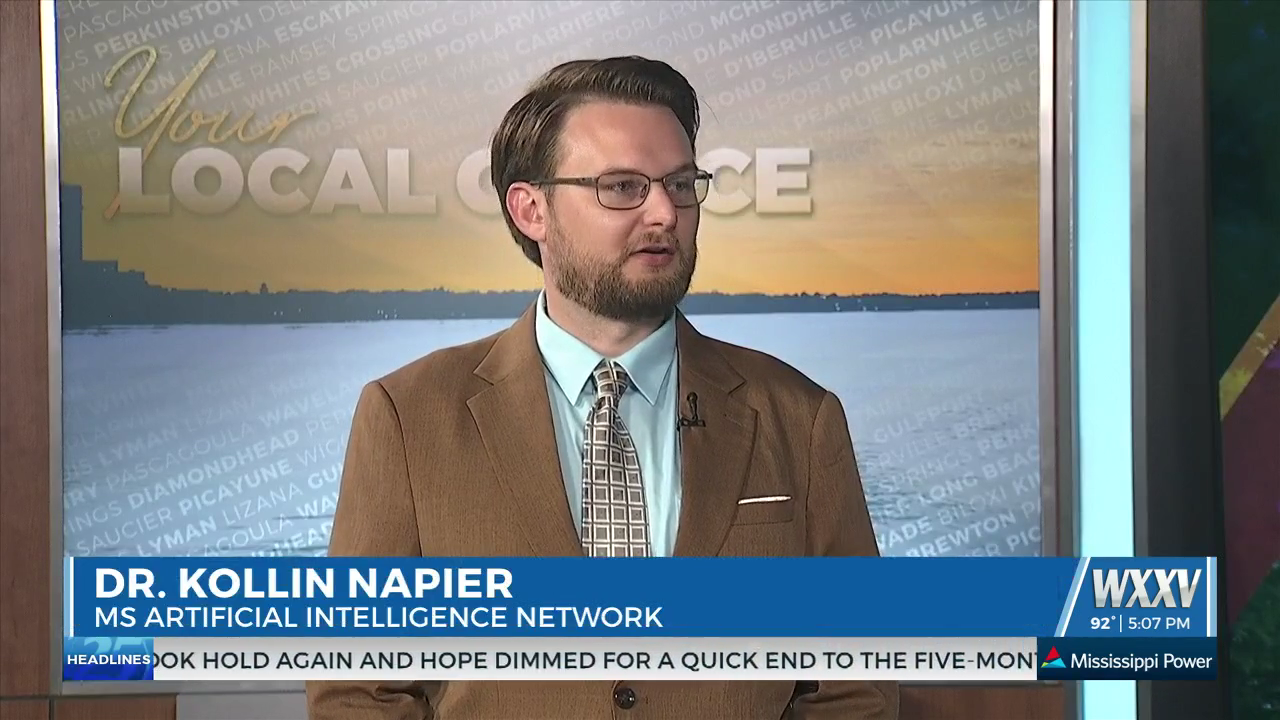
Watch the WXXV interview
Video courtesy of WXXV News 25. View the original WXXV report.
The Mississippi Legislature created the task force through Senate Bill 2426 during the 2025 Regular Session. The task force studies AI applications, risks and state-government use. It also considers possible revisions to the Mississippi Code. Its work spans privacy, data protection, ethical standards, liability, consumer impact, bias, copyright and the provenance of AI-generated material.
Watch the full interview and read the original WXXV coverage.
What is the Mississippi AI Regulation Task Force?
The Mississippi Legislature established the Artificial Intelligence Regulation Task Force to study AI in state law and public policy. Its charge is broader than deciding whether to regulate a single tool. Members review AI use across sectors and compare federal and state approaches. They also consider state-government applications and develop recommendations for the Legislature.
“We have to look at AI across all sectors because it impacts everybody,” Napier said during the WXXV interview.
That cross-sector view matters because AI is already present in hospitals, banks, schools, businesses and public agencies. A policy decision in one area can affect privacy, cybersecurity, workforce preparation, consumer protection and economic development elsewhere.
The law directs the task force to balance innovation and the public interest. At the same time, members must consider the risks and unintended consequences of both AI and its regulation. The group reports its findings and recommendations to the Mississippi Legislature annually. MAIN maintains a public overview of the AIR Task Force with membership information, official documents, meeting coverage and frequently asked questions.
Data center hearings brought competing perspectives to the Capitol
Napier also discussed the task force’s July 13–14 hearings at the Mississippi Capitol on data center development. Data centers provide physical computing infrastructure for AI systems and many other digital services. However, their growth raises practical questions for communities and policymakers.
Over two days, the task force heard from several groups. Participants included public-interest advocates, utility stakeholders, data center representatives and municipal officials. Local and state economic development organizations also testified. The testimony addressed both potential benefits and concerns. Topics included infrastructure demand, utility planning, water use, noise, economic incentives, jobs and community impact.
The hearings did not reduce those questions to a simple choice between development and opposition. Instead, they gave the task force a public record of the tradeoffs that state leaders and communities must evaluate as demand for computing infrastructure grows. Read MAIN’s coverage of the two-day data center hearings.
Existing laws still matter when AI is misused
During the interview, Elliott asked about misleading AI-generated audio, images and video. Napier noted that harmful conduct does not become lawful simply because a new technology is involved. Mississippi already has laws that can apply to fraud, impersonation and other illegal or illicit behavior, just as existing rules have long applied when older editing tools are misused.
The task force can therefore examine where current law already addresses harmful conduct. Members can then identify where Mississippi needs specific revisions. That approach helps lawmakers focus on identifiable harms, responsibilities and enforcement gaps instead of treating every use of AI as the same.
Why AI literacy is part of responsible policy
Asked what he would say to people who are uneasy about AI, Napier emphasized education. Some concerns reflect real questions about privacy, accuracy, jobs, security and accountability. Others come from confusion about what AI is and how long it has been part of daily life.
Generative AI made the technology much more visible, but AI has supported familiar services for years, including route selection, recommendation systems, fraud detection and automated sorting. Literacy helps people distinguish those established uses from newer generative tools and evaluate each application on its actual capabilities, limits and risks.
MAIN provides no-cost AI courses for Mississippians covering AI foundations, practical use and workforce readiness. Through these courses, learners can ask better questions and verify outputs. They also learn to protect sensitive information and recognize where human judgment remains essential.
Key takeaways from the WXXV interview
- The task force’s scope is statewide and cross-sector. AI policy affects education, healthcare, finance, government, business, infrastructure and the workforce.
- Its mission requires balance. Senate Bill 2426 directs members to consider innovation and public interest together, including the consequences of regulating too little or too broadly.
- Data centers require a continuing public conversation. Communities, utilities, companies and economic development organizations have different evidence and responsibilities to bring to the discussion.
- Existing law remains relevant. Policymakers can identify where current statutes already cover harmful conduct and where AI-specific revisions may be justified.
- AI literacy supports informed participation. Education helps residents evaluate claims, recognize risks and make practical decisions about AI use.
Learn more and take the next step
Readers can review the Mississippi AI Regulation Task Force overview, including Senate Bill 2426, the task force’s first annual report and related meeting coverage.
Mississippians who want a practical introduction to AI can browse MAIN’s no-cost online training opportunities. Course information is available for learners across occupations, sectors and experience levels.
Frequently asked questions
What does the Mississippi AI Regulation Task Force do?
It studies AI applications, risks, state-government use and potential changes to Mississippi law. It also reviews policy developments elsewhere and reports findings and recommendations to the Legislature.
When was the task force created?
The Mississippi Legislature created the Artificial Intelligence Regulation Task Force through Senate Bill 2426 during the 2025 Regular Session.
Is Dr. Kollin Napier a member of the task force?
Yes. Senate Bill 2426 includes the Director of the Mississippi Artificial Intelligence Network, or a designee, as a voting member. Dr. Kollin Napier serves in that role.
Why did the task force hold hearings about data centers?
Data centers are part of the physical infrastructure that supports AI and other digital services. The hearings examined potential benefits and concerns involving utilities, water, communities, economic development and workforce impact.
Where can Mississippians learn about AI at no cost?
MAIN offers no-cost online AI training for Mississippians. The MAIN course catalog lists current opportunities.
Sources: WXXV News 25 interview and coverage by Dave Elliott; Mississippi Senate Bill 2426; MAIN’s Mississippi Artificial Intelligence Regulation Task Force overview; and MAIN coverage of the July 13–14, 2026 data center hearings.
Related: AI in Mississippi