
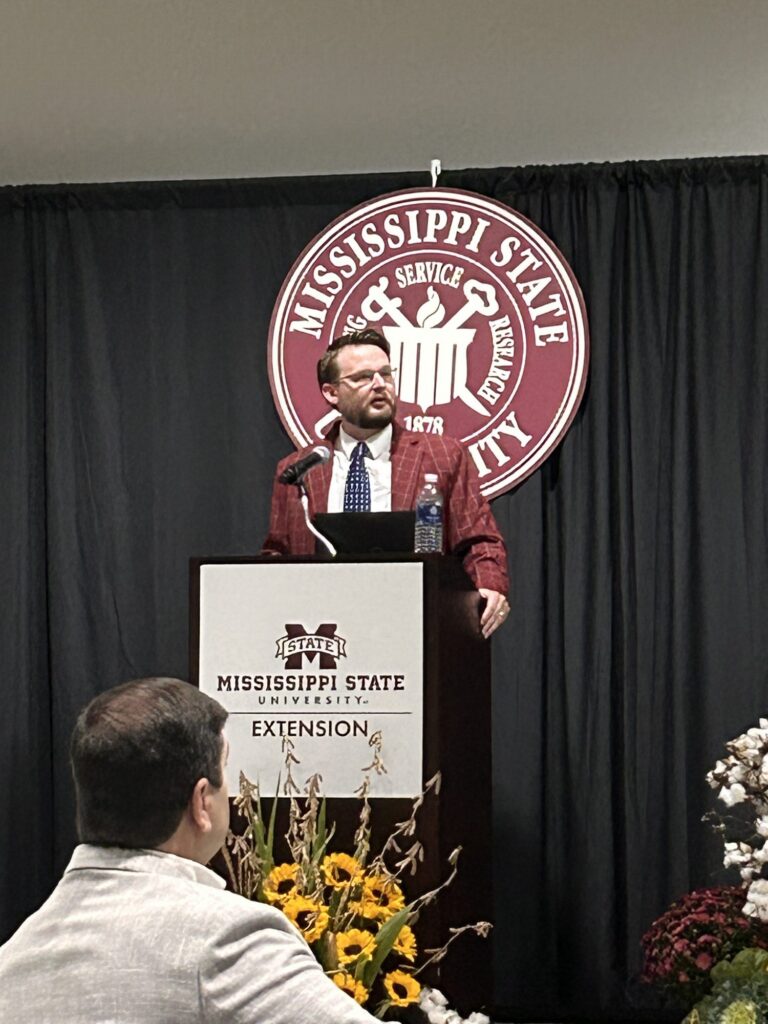
Dr. Kollin Napier, Chief Artificial Intelligence Officer of the Mississippi Artificial Intelligence Network (MAIN), delivered the keynote address at Mississippi State University Extension’s 2026 Annual Conference on November 6 in Starkville. Speaking to hundreds of Extension personnel, from county agents to specialists and Extension leadership, he focused on where AI can save time in Extension work, where it falls short, and how agents stay in charge of what goes out.
The keynote, “Practical AI for Extension: Saving Time, Strengthening Service,” followed a welcome from Dr. Angus Catchot, Director of Extension, in Bost Auditorium. It was also a return to Extension for Dr. Napier, who worked at MSU Extension as a software architect in the Center for Technology Outreach before MAIN and holds a Ph.D. in computer science from Mississippi State. He opened by crediting the organization: “I can confidently say I wouldn’t be where I am today without the Mississippi State University Extension Service.”
“You bring the expertise,” Dr. Napier told the audience. “AI can help with the first draft. You decide what goes out.”
Agents, then and now
Dr. Napier described AI tools moving from answering questions to taking steps on a user’s behalf, such as looking something up, filling in a draft or preparing a message. “AI just got agents,” he said. “Extension has had them since 1914.” The Smith-Lever Act of 1914 established Cooperative Extension, and he tied the comparison to what good county agents already do. They know the people, know the facts and use judgment, and AI still needs that judgment from a person.
The Extension Foundation’s National AI Report 2026 reached a related conclusion. After sessions with agents, educators and specialists, the report found that “a strong consensus emerged that workforce readiness is the most significant barrier to AI adoption.”
Three rounds of checking AI’s work
Dr. Napier described a prompt as a work assignment for a new staff member. A useful one names the task, the audience, the source to use, what not to invent and what to return. Clear instructions make a draft easier to check, and the agent still has to check it.
A day after the conference’s Extension Agent Quiz Bowl, he ran a shorter quiz of his own, with the audience voting by show of hands. In the first round, a parent asks how to join 4-H, and an AI draft written without local information invents a Saturday meeting time and a $10 fee. “AI doesn’t know your county,” he said. “You do.”
The second round used a real response from an AI tool that turned fictional planning notes into a follow-up email. It got every task, owner and date right, then added a request for volunteers that was not in the notes. Keeping the line and cutting it were both reasonable choices. “The tool drafts,” Dr. Napier said. “You decide.”
The third round adapted a handwashing tip for home cooks. The draft read well but left out how long to scrub and where, which FoodSafety.gov specifies as at least 20 seconds, including the backs of hands, between fingers and under nails. Missing details are harder to catch than wrong ones, he said, because nothing on the page looks wrong, so agents should check drafts against the source and have a specialist review anything they will teach.
Starting with tools MSU already provides
Dr. Napier pointed agents to the tools Mississippi State lists for faculty and staff on its AI Hub, including Maroon Chat, Microsoft Copilot and Google Gemini with NotebookLM, all accessed with an MSU NetID. He summarized the Hub’s employee guidance on what information can go where. Public information may go into public tools with model training turned off. Information available only with a NetID stays in MSU-licensed tools. Regulated or personal data requires approval first, or full de-identification. AI-generated content gets human review before it is made public.
Extension is also building AI training of its own. Dr. James Barnes’s AI to Answers program, presented at the conference the previous day, is developing AI-focused marketing training for agricultural entrepreneurs and Extension professionals through a stackable credential pathway.
One task, one week
Dr. Napier asked each agent to pick one task, such as replying to a question they answer all the time, turning meeting notes into next steps or adapting a fact sheet for a new audience, and try it for one week with approved sources and an approved tool. He asked them to count all of the time, including checking and fixing, and to stop using AI for that task if it does not save time or improve the work. “That’s a good result too,” he said.
Free MAIN resources for every county
MAIN’s 18 online, self-paced AI courses, including Microsoft 365 Copilot, are free for Mississippi participants, with enrollment open through June 30, 2027, while seats and licenses last. Dr. Napier also highlighted the AI Policy Supplement for Agriculture and Forestry, a planning guide for operations deciding what farm data and permissions an AI tool should have, and 100 Beginner ChatGPT Prompts for Small Business, which agents can share with local businesses they serve.
MAIN is Mississippi’s statewide AI initiative and the first of its kind in the nation, based at Mississippi Gulf Coast Community College. It began with Mississippi’s colleges and universities and now connects every public and private university and community college in the state with government, workforce and industry partners. Mississippi State is already a MAIN partner. Extension has an office in all 82 counties, and Dr. Napier asked agents to use that reach. They can learn AI by taking a free course and trying one task, model it by showing what a checked draft looks like, and share it by pointing the people they serve to free resources.
“MAIN is ready to partner with Extension to take this to every agent and every county,” he said.
Upcoming opportunities include the free MAIN x Microsoft AI Workshop for Mississippi public-sector leaders on December 3 at The Mill at MSU, and the MAIN Event, Mississippi’s statewide AI conference, on April 12–13, 2027. Both are listed on MAIN’s events page.
MAIN thanks Dr. Catchot and MSU Extension for the invitation to address this year’s conference.
Event organizers can explore Dr. Napier’s speaking topics and contact MAIN about a keynote, workshop or executive briefing.