
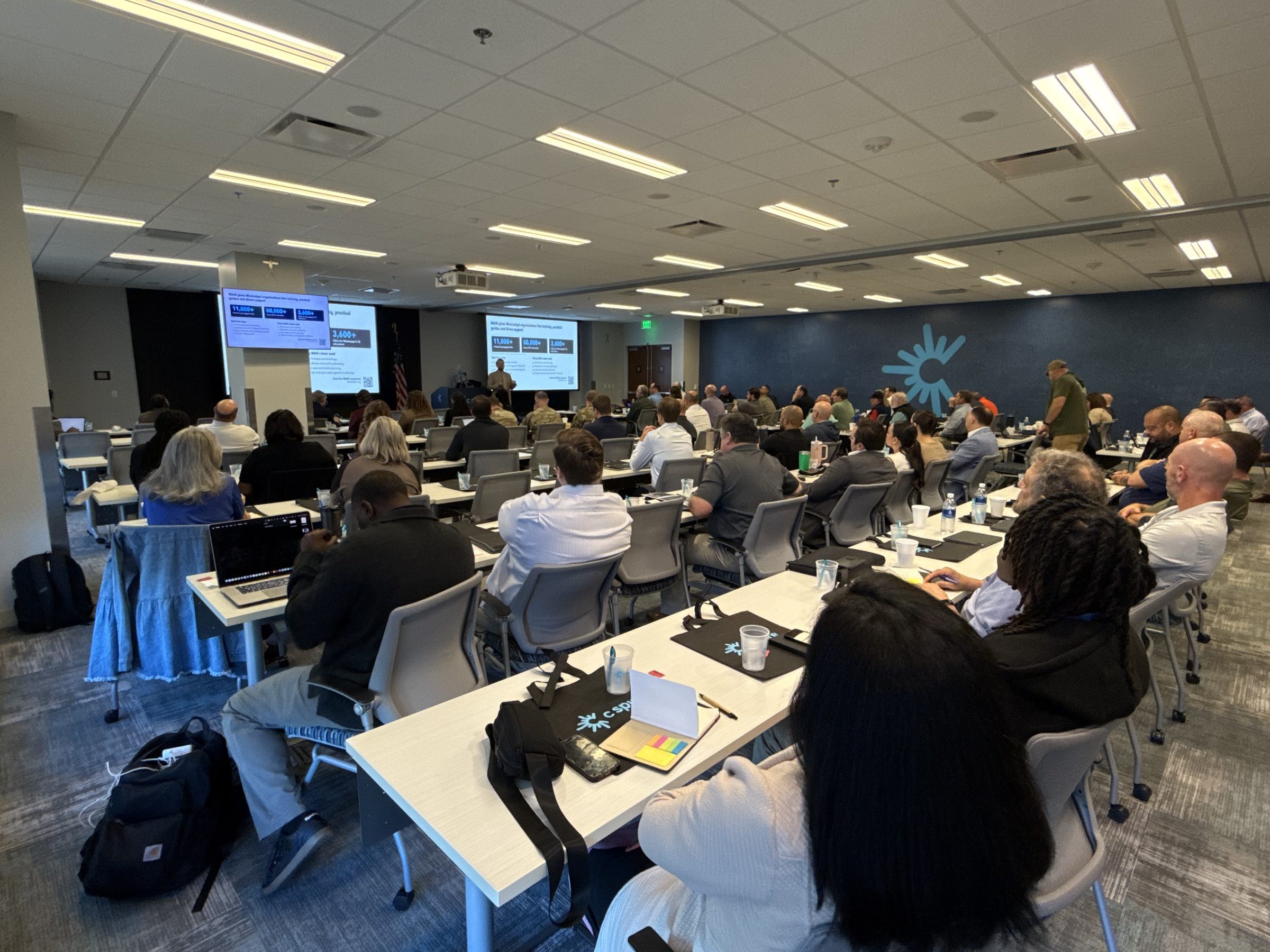
Dr. Kollin Napier, Chief Artificial Intelligence Officer of the Mississippi Artificial Intelligence Network (MAIN), opened the 2026 ASIS/InfraGard Security Summit on November 5 at C Spire’s corporate headquarters in Ridgeland. His session covered how AI is changing security work and the no-cost MAIN training and guidance available to Mississippi security teams.
The summit is the 14th annual event organized by ASIS International’s Jackson, Mississippi Chapter 80 and InfraGard Mississippi. Organizers aimed it at physical security and cybersecurity professionals, government, law enforcement and military personnel, emergency responders, and educators and students. Dr. Napier’s session followed the welcome and opening remarks.
Dr. Napier opened with two questions for the room: What AI is already running in your organization, and what can it reach? Before an organization can secure AI, he said, it has to know both.
AI use is outpacing security maturity
Dr. Napier cited the SANS Institute’s 2026 AI survey of 536 security practitioners and 57 senior leaders worldwide. In 2026, 78% of organizations reported actively using AI in their cybersecurity strategy, up from 50% in 2025. Only 27% of practitioners described their deployment as mature production. Dr. Napier described that gap between use and maturity as the reason organizations need training, written guidance and oversight now.
He also pointed to research OpenAI published on November 4, the day before the summit. An AI pipeline the company built produced exploits for 948 distinct Linux kernel privilege-escalation vulnerabilities in an October run, at a cost of about $1.21 million in API credits, or roughly $1,280 per exploit, CSO Online reported. OpenAI said human researchers review the findings and proposed fixes before reporting them to Linux maintainers. Dr. Napier told the room that anything AI makes faster and cheaper for defenders is becoming faster and cheaper for attackers too, so organizations should patch sooner, limit who and what has access, and train everyone who can click a link.
Where Mississippi’s policy work stands
Dr. Napier, who serves on the Mississippi Artificial Intelligence Regulation Task Force and chairs the AI Workforce Readiness Council, summarized recent state activity. The task force, established by Senate Bill 2426, met September 15 at Camp Shelby to examine how AI is changing cyber threats and what safeguards state systems need. The Senate Select Committee on Cybersecurity held an October 13 hearing on AI risks and response gaps as it develops recommendations for the 2027 legislative session. On workforce skills, the Mississippi Statewide AI Framework sets out 11 competency domains that address emerging security risks involving agentic systems and synthetic media.
MAIN informs that policy work and helps organizations build AI skills. It does not regulate or approve AI systems.
No-cost resources for security teams
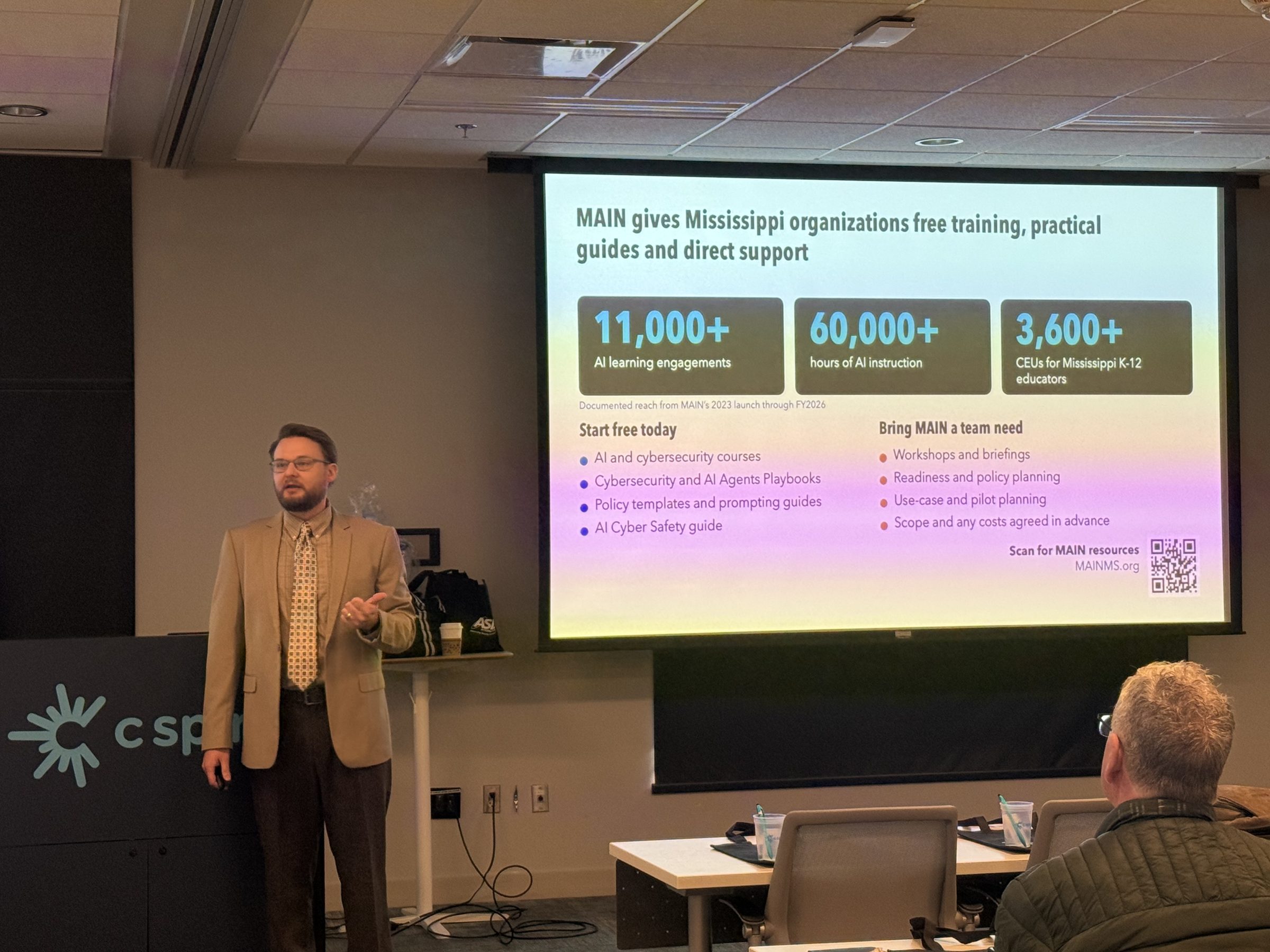
Most of the session covered MAIN resources that security, public-safety and critical-infrastructure teams can use now. MAIN, Mississippi’s statewide AI initiative, is based at Mississippi Gulf Coast Community College.
Dr. Napier matched three free online courses to roles in the room. Generative AI for Everyone covers how AI works, where it fails and everyday workplace uses. AI in Cybersecurity has learners verify fictional alerts and build a capstone portfolio. Generative AI Cybersecurity & Privacy for Leaders: A Primer covers impersonation, prompt injection and privacy risk. MAIN’s courses are free for Mississippi participants, with enrollment open through June 30, 2027, while seats and licenses last.
MAIN’s Cybersecurity AI Playbook starts with an inventory of AI-enabled systems. Using a camera system with AI analytics as an example, Dr. Napier listed five questions to answer before one joins a network: who owns it, what it can access, where its data goes, how long footage is kept, and how to shut off its access in an emergency. If that system later gains an AI agent that can take actions, MAIN’s AI Agents Playbook covers permitted actions, named reviewers and who has authority to stop it.
MAIN’s library of 10 model AI policy guides includes templates for businesses and local governments and a supplement for law enforcement agencies. Each addresses approved tools, what information staff may enter and who reviews AI output. They are starting points for organizations to adapt with counsel and with IT, privacy and records reviewers.
The AI Cyber Safety guide, written for every employee, asks three questions before anyone connects an AI app to a work account: which account it uses, what it can read, send or change, and whether that access persists. Changing a password may not remove an app’s existing access, which has to be revoked in the connected service. Account access and impersonation led into the next session, Mike Rieger of BCI on business email compromise.
The rest of the summit program
The summit agenda also included Mike Jackson of Elite Edge on smart glasses risks and protective measures; Bobby Freeman of the Mississippi Cyber Unit on the cybersecurity role of the Mississippi Office of Homeland Security; an optional tour of C Spire’s network operations center; and Keith Young of C Spire on AI for the security practitioner. An InfraGard Mississippi meeting followed the summit.
Working with MAIN
Dr. Napier closed by inviting organizations to bring MAIN one workflow or training need, along with the people who own the decision, such as security, IT, legal or records, and operations staff. MAIN agrees on scope, timing and any costs before work begins. Details are on MAIN’s services page, or email main@mgccc.edu.
Upcoming opportunities include the free MAIN x Microsoft AI Workshop for Mississippi public-sector leaders on December 3 at The Mill at MSU in Starkville, and the MAIN Event, Mississippi’s statewide AI conference, on April 12–13, 2027. Both are listed on MAIN’s events page.
MAIN thanks ASIS International Jackson Chapter 80, InfraGard Mississippi and C Spire for organizing and hosting the summit.