
The Mississippi Artificial Intelligence Network (MAIN) closed a three-stop campus road show in Hattiesburg on November 12, completing a week that took Explore AI on Mac: A Hands-On Campus Experience to the University of Mississippi, Mississippi State University and The University of Southern Mississippi. Participants spent each session working with AI models that run directly on a personal computer and discussing where that approach could fit in teaching, research and university operations.
MAIN co-hosted the series with Apple Higher Education, the technology solutions provider Connection, and each host university. The sessions ran on consecutive days, starting in Oxford on November 10, continuing at Mississippi State’s Office of Research and Economic Development in Starkville on November 11 and ending in Hattiesburg with USM. No coding experience was required, and seating was limited to keep the work hands-on.
Why it matters where AI runs
Most people use generative AI through cloud services, which send a prompt and any attached files to a provider’s servers for processing. A local model does that processing on the computer itself. For a university, the distinction affects where information goes, what each request costs and whether a tool keeps working without a network connection.
“Being able to run AI locally gives us another option to consider for campus work, especially when we’re thinking about where information goes,” said Dr. Kollin Napier, Chief Artificial Intelligence Officer of MAIN, after the opening session in Oxford.
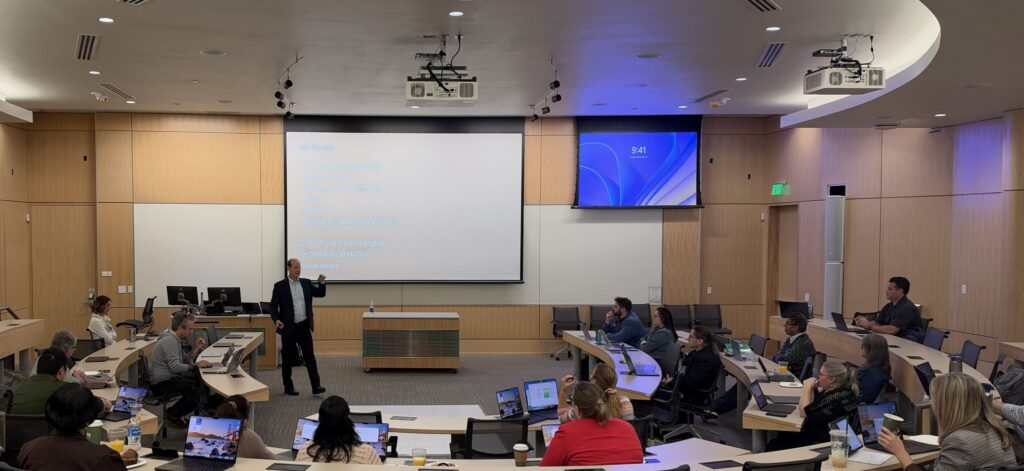
The workshop treated local AI as one option alongside cloud tools. Its take-home guidance suggests using cloud models for work that involves no sensitive data, such as writing code, and keeping AI that handles institutional data on the device. The guidance also asks participants to use only sample or approved data until their institution has reviewed a workflow, and the files used during the labs were synthetic or public.
From built-in features to building an app
The labs moved step by step from familiar features to more advanced work. Participants began with AI capabilities built into macOS, including Siri, visual intelligence and Shortcuts. They then chose open-weight models in LM Studio, a desktop application for running models locally, measured how the models performed, shaped their behavior with instructions and ran them with Wi-Fi switched off.
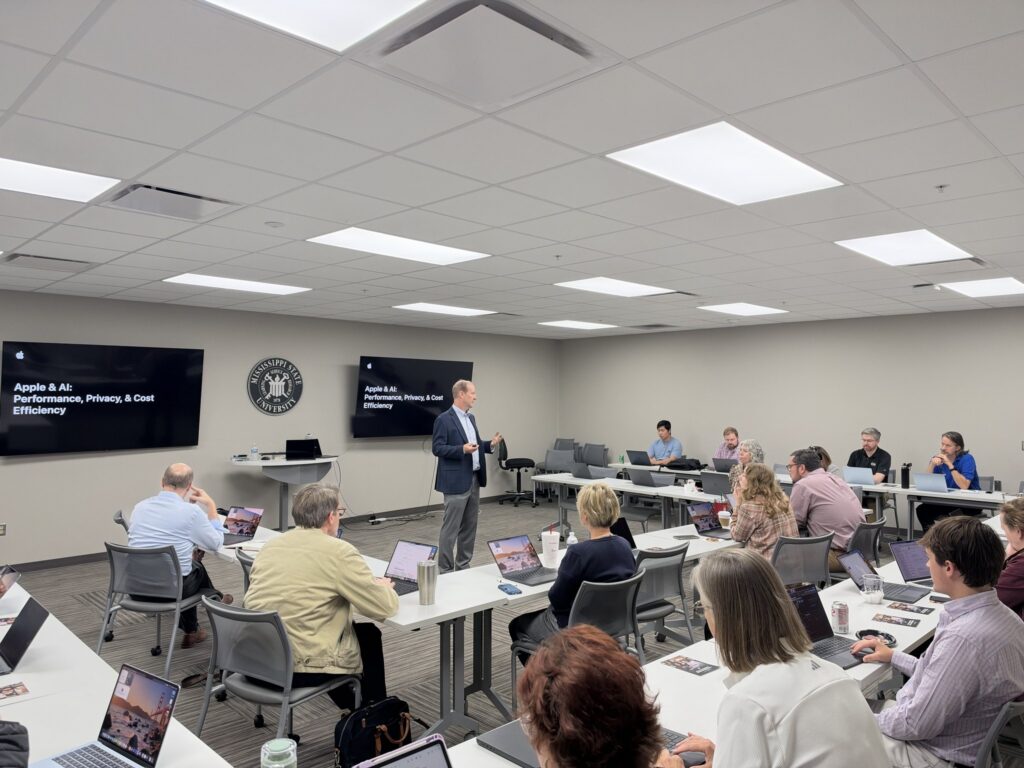
Later labs handed real tasks to AI agents. One agent built a small app from a participant’s design, and another completed work on its own. A closing demonstration showed several Mac computers pooled into a single, larger AI computer.
“I want people to have time to try these tools and work out where they might actually help,” Dr. Napier said of the Starkville stop. “That includes understanding what runs on the device and what uses the cloud.”
Users and IT staff in the same room
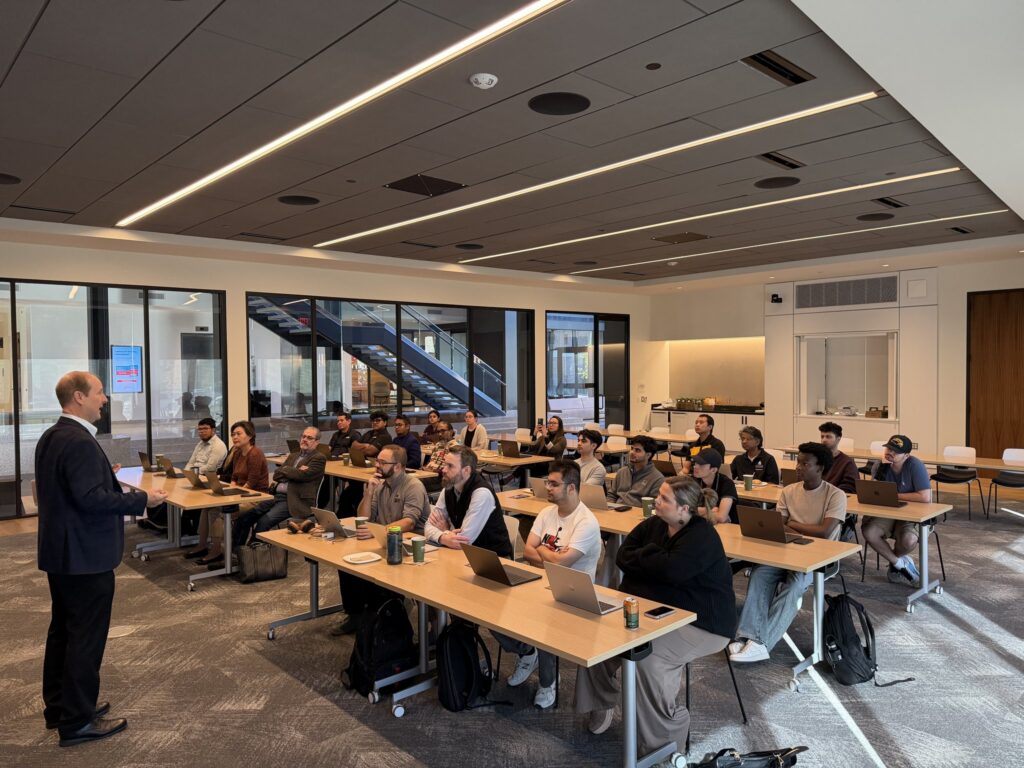
The series was designed for the people who would use AI in their work and the people who would support it. Registration was open to IT leaders and staff, faculty, researchers, and academic staff and administrators, and the sessions included discussion of campus opportunities and the considerations IT teams weigh when supporting adoption.
“I like having the people using AI and the people supporting it in the same conversation,” Dr. Napier said after the final stop. “They’re looking at the technology from different angles, and both need a say in how it fits on a campus.”
Carrying the work back to campus
Participants left with a lab guide and a set of take-home challenges meant to carry the work into their own departments. The challenges include automating a recurring summary, writing instructions that turn a local model into an assistant for one document-heavy task, connecting an AI tool they already use to a model running on their own Mac to compare it with the cloud version, and drafting a one-page proposal for running a departmental workflow locally that describes the data involved and the expected gains in performance, privacy and cost.
Keep learning with MAIN
Mississippians can continue with MAIN’s no-cost, self-paced AI courses. Upcoming sessions, including a December 3 hands-on AI workshop for public-sector leaders at Mississippi State, are listed on the MAIN events page.
About MAIN
The Mississippi Artificial Intelligence Network (MAIN) is Mississippi’s statewide AI initiative and the first of its kind in the nation, based at Mississippi Gulf Coast Community College. MAIN began with a focus on higher education, and Mississippi’s community colleges are partners in the network. Today MAIN connects education, workforce, government, industry and community partners and provides AI learning opportunities, practical resources and responsible-adoption guidance. Learn more at mainms.org.